Saturday, 29 September 2012

A Century of War


A century of war is about to close.  It began with the sinking of the Titanic in 1912, the largest ship in the world, sunk on it's maiden voyage. On board, the UK's finest and wealthiest, a floating meeting of the Bilderberg Group.  History recorded a collision with an iceberg. Yet the only mountain in the course of history was WWI and the intolerable living and working conditions of the early 20th century, when average life expectancy for a man was just 46 years, a day at work for the poor lasted an average of 12 hours. To make matters worse, the wealthier in society depended upon household staff. Never was class disparity so held up in the face of those employed to carry out very personal, often dirty and manual labour. A wealthy household might employ staff to clean toilets, wash clothes, clean the house, maintain a garden, all tasks which starkly contrast social position, underscoring the class division between those living upstairs and those toiling at all hours downstairs. Today the coal face roles have been displaced by dishwashers, washing machines and other household appliances, whilst high quality pre-prepared food and many other labour saving technologies and modern conveniences have done away with class contrasting dependence upon man servants. Women within low income groups at that time, were practically enslaved within marital domestic servitude, the working class atomic unit depending upon such unequal social structures.

Europe's half a millennia of industrialisation created the burgeoning middle and upper classes of the early 1900s, capitalism's echelons of people and revenue mountains were highly ordered for the period. Europe was the world's hub of science, industry and commerce. Raw materials were brought here, to be processed using technologies that only existed here, before being traded locally or exported to marvelling lower-tech countries. We were rich imperial nations. Nothing was going to deter European capitalists from their vision glimpsed upon the blue Danube. In contrast with Russia's widely distributed and excessively poor land labourers, many people in Europe would be displaced from positions of power by radical change in political ideology. 

The process of redefining monarchy and the church has continued gradually since the 12th century, emerging from the dark ages with civilisation, shifting power toward the people and society's industrialists, bringing us to the position we have today where in most nations the monarchy continue only as figureheads or as a model of familial structure. Ultimately, nepotist feudal rule was no match for meritocratic industrialism, rendering the richest men in society no longer monarchs, taxes in the UK being paid directly to government since the late 17th century.

It is the source of much human suffering that capitalism and communism are mutually exclusive systems of governance, they cannot peacefully co-exist.  Since the invention of WMDs, with the volatility of political extremism, the absolute necessity of incremental revisionism over revolution is almost universally accepted. Yet it cannot be understated that the force which will emancipate mankind from hardship is technology and not any specific political doctrine. Communisms drive to bandage the lowest knee, over capitalisms potential for the amoral pursuit of profit, would seem clearly preferable to any compassionate human.  Yet paradoxically efficiency is a greater motivation for technological innovation. Innovations which today bring to the majority what a hundred years earlier were only available to the wealthy upper classes of our planet. 

The majority of us have been freed from laborious domestic chores. Whilst a night at the opera, the theatre or a musical performance may be enjoyed by all, even on a modest income. Travel to regions of the world, just a few decades earlier considered remote and exotic to most of us, is now possible for the majority. 

A hundred years of war, from which we may conclude: we must always strive to make available to the majority the life style enjoyed by the more privileged, always seeking to eradicate manual labour and suffering. Our objective must be the emancipation of humanity thru technology. 

This entry was inspired by a a three part documentary currently being screened by the BBC: "Servants: The True Story of Life Below Stairs"

Tuesday, 9 August 2011

Comment: There's no future for the eurozone without fiscal union. Lydia Prieg. Guardian.

Original article link: http://www.guardian.co.uk/commentisfree/2011/aug/09/eurozone-fiscal-union-europe
Similar mismatches occur with interest rates. Without national currencies there is no mechanism to make sure that eurozone nations' imports and exports between themselves ever come back into balance.
Why are we surprised that the nation at the centre of the European Union is the most financially successful, whilst those archipelagos nations on the periphery struggle to compete? The ERM should compensate for this on the basis of a nation's resources and the circumstances of geography.

Instead, Europe needs a more honest and nuanced debate. There are many options for reform, including reintroducing some domestic currencies alongside the euro, alternative mechanisms for preventing persistent current account imbalances within the eurozone, as well as a range of degrees and means of fiscal integration.

I wonder if at present there is a reluctance to discuss the dirtier side of our economies with each other? Is it this that prevents nations relinquishing more power to the EU whilst accepting governmental consultancy from fiscally successful nations? An even darker secret seems to be the macro economic history of the past two decades, the western economies have bucked and rippled as the economic wave of Russia and China's incorporation into the global economy ebbs within the system, facts the economists never reveal on news shows.

Alas under capitalism there is no idealism without economic wealth, yet every year improvements in technology reduce the cost and man power required for production. It has been a long time since the gold standard was abolished, today perhaps the only measure of currency is in the self belief of a nation or group of nations to do good and lead us forwards. Yet go forwards we must, accepting that we are willing to support each other, that is the direction of civilisation and the only economy worth valuing!

Tuesday, 17 May 2011

Gender Equality


Alas the privileges and freedoms we have as men and women are not equal. Yet it is also true to say that neither sets of rights, for the male or the female, encompass the other: if today we gave women all the same advantages that men have, the system would be biased in favour of women. This reveals the oldest dichotomy in human history: between the sexes we support each other, though often in very symbiotic, rather than equivalent ways. Regardless we must strive to ensure that the same options are available to both sexes.

Marxists argue that without understanding sexual identity thru the lens of capitalism, we are presented with many contradictory and reactionary positions, the effects of wealth at every echelon of society affecting those contradictions, that it is - quantifying the value of these roles under capitalism introduces inequalities in the dichotomy: raising a child does not always guarantee the same monetary returns as working as a banker, doctor or barrister and certainly not in the short term. Free market capitalism does not value us equally. 

From where does this inequality stem? The problem must surely lie in the various forms of sexual segregation we undergo during education, particularly in sporting activities where the early opportunity to undermine later misconceptions and other imbalances between the sexes is not realised.

The UN has the following to say on gender equality in sport:
"Sport provides women and girls with an alternative avenue for participation in the social and cultural life of their communities and promotes enjoyment of freedom of expression, interpersonal networks, new opportunities and increased self-esteem. It also expands opportunities for education and for the development of a range of essential life skills, including communication, leadership, teamwork and negotiation. 
The participation of women and girls in sport challenges gender stereotypes and discrimination, and can therefore be a vehicle to promote gender equality and the empowerment of women and girls. In particular, women in sport leadership can shape attitudes towards women’s capabilities as leaders and decision-makers, especially in traditional male domains. 
The positive outcomes of sport for gender equality and women’s empowerment are constrained by gender-based discrimination in all areas and at all levels of sport and physical activity, fuelled by continuing stereotypes of women’s physical abilities and social roles. Women are frequently segregated involuntarily into different types of sports, events and competitions specifically targeted to women. Women’s access to positions of leadership and decision-making is constrained from the local level to the international level. The value placed on women’s sport is often lower, resulting in inadequate resources and unequal wages and prizes. In the media, women’s sport is not only marginalized but also often presented in a different style that reflects and reinforces gender stereotypes. Violence against women, exploitation and harassment in sport are manifestations of the perceptions of men’s dominance, physical strength and power, which are traditionally portrayed in male sport."
UN Inter-Agency Network on Women & Gender Equality, "Women, gender equality and sport."
This early segregation of our social development and later into fraternity and sorority groups would seem to be the cornerstone of the division of the sexes. There is clearly a need for integration in sport, instead grouping athletes by ability and not gender, whilst providing more televised coverage of sexually integrated events. Otherwise we must continue our perpetual lament of the sexual disparity we see as a result of our initial sabotage, continually restarting the feminist fight with each new generation.

Sunday, 30 May 2010

Cumulonimbus

The more people communicate, the more objective truth there is in the world. If human society functioned in any other way, we would have perished long ago. Concurrently the rise of social networking is redefining the fabric of society in a way that hasn't occurred since the invention of the telephone.

The majority of us agree that this is a positive dynamic, allowing society to healthily police itself. More conservative and especially criminal, opportunist elements, particularly aspects of the state which have become self perpetuating, fear increased communication will shed light upon the inequalities within society which they have managed to use to their advantage.

In the future are we likely to see social networks prioritize posts in order to silence political activists and future politicians? Will our communication be sabotaged in other ways? We may never again see the likes of the huge social networks such as Facebook or Twitter. The establishment would prefer networks become smaller, more specialized, perhaps focused around social identities such as newspaper brands or location. Or even entirely state controlled.

There is some suggestion that the real justification for the establishment’s fear of social networks is their misconceived potential to bring political revolution. Yet I believe these concerns are entirely unfounded. If we consider society in the decades which lead to the rise of communism in Russia, life for the majority of us was extremely arduous, child labour and poverty were rife, the welfare state was in its infancy, whilst a twelve hour working day was common place. Life expectancy for an average male was just 48 years. The refinement of the manufacturing process from Ford's early assembly lines to today's almost completely automated factories, has brought with it leisure and to some extent luxury in comparison with earlier centuries. Innovations in science and medicine, along with welfare reform have extended average life expectancy to over 70 years for most of us. We now hope with some complacency, the revision of the proverb "Teach a man to surf" will cure all of humanity's ills.

Increased dependency upon cloud hosting to provide social networks brings with it several vulnerabilities. In many ways a comparison may be drawn with a media having only one newspaper or television channel. A primary concern being that it is relatively easy for one of the social network's employees to silence or persecute a member of society, deprioritizing their posts or silencing them completely without the person's awareness, playing down politically contentious issues. Most disturbingly facts may be hidden: the results of opinion polls may not reflect the public's real beliefs. These dangers could also be surreptitiously factored into the design of the system and political bias subsequently bought and sold.

Relying on a single privately owned company to provide such facilities is clearly putting all of our eggs in one basket, a situation which may be compared to everyone on the planet using one telephone company. Whilst many different networks would not provide the same experience of communicating with all of our friends or colleagues en masse, how tall should any one building be?

The cloud has been in the corporate incubator for long enough. A community solution would seem a safer approach. If not one akin to Wikipedia, then perhaps a peer to peer cloud platform, borrowing from distributed computing projects like SETI at Home and Folding, whilst adopting Linus Torvald’s "Git" philosophy, could provide the necessary infrastructure for a community hosted social network.

Wednesday, 24 March 2010

Emergence


At the start of the 20th century we elected individuals who would address our concerns locally and represent our ideals nationally in parliament. MPs would travel by horse or carriage; and later trains and automobiles to the offices of government. Daily corresponding via post and telephone with members of local government and lobbyists, who occasionally would seek an audience in person.

Today mass electronic communication such as web forums, social networks, e-mail, mailing lists, Twitter, RSS, rolling news and article discussion along with a myriad others are transforming our political dinosaur. As much as many politicians would prefer to deny it, these technologies are forms of political conference and debate, in effect expanding the House of Commons until every office and home in the nation is encompassed.

Consider how the modern office has transformed in the past two decades and how these technologies now affect politics:
  • Ideas are being exchanged and challenged, whilst groups of people are helping to present solutions to issues raised by journalists and MPs. A consequence of this is that it is more difficult to remove the resident political party, since morale is constantly being bolstered by the level of enthusiastic political debate.
  • MPs may instantly call a vote via e-mail across the party, including MPs and local government representatives, obtaining a collective decision within hours or minutes, making it much more difficult to make that stupid mistake that loses public favour.
  • In the past politicians where more isolated and likely to become demoralized, electronic communication creates cohesion and unity of resolution.
  • What previously was a document arriving by post or courier is now a social website, changing from moment to moment as people discuss ideas and resolve solutions.
  • Policy dictated by the few to the majority of the party is now clarified by rapid electronic debate.
  • The acceleration of dialogue and decorum of literary communication between all members or smaller groups of the party creates solidarity, whilst also liberating cabinet ministers from the cult of personality.
Every individual has a voice that may reach every person on the planet if necessary, promoting transparency in politics, law and economics. As a result society is more capable of policing itself: Citizen Kane if not dead, certainly seems to be losing his head.

Fused and yet in constant flux, from opinions evolving within a billion conversations around the world, emerges a new form of political expression, an energy grass roots canvassers could hardly have imagined, a wave from which politicians need only cherry pick solutions and inspiration from the dialogue contained therein.

Government at its best is mundane and honest administration. Telecommunications networks overcome the hurdles that brought celebrity politics, the sooner we move to issue based political campaigning, perhaps by accelerating the electoral process and so fragmenting the existing monolithic political entities, the better for us all.

Tuesday, 9 February 2010

Why do Empires Fall?


Throughout the animal kingdom, we see the weaker of the group fall prey. Apart from the group we are predatory; a sly fox finds a victim. Evolution is amoral in order to survive in the direst circumstances, from the predator we find that this amoral opportunism manifests itself as criminality in human society.

In the last century alone the lives of more than 50m people have been lost in wars fought over political ideals, territory and resources, events which are all testament to the perilous journey that is the technological ascent of man. Clearly political stability is paramount to our survival here on Earth. Yet we are undermined, in time complicity with criminal opportunism blocks the arteries of egalitarian governance, bringing leaders into disfavour whilst causing migration and ultimately empires to decay and fall.

"Transparency", used to denote openness and accountability, is becoming common parlance in politics. Historically transparency has its roots in Sweden, when in 1766 the Freedom of the Press Act was introduced, granting the public access to government documents, though this brief ray of Scandinavian wisdom wasn't seen again until 1966 when the US introduced the Freedom of Information Act. Since then over 80 countries around the world have introduced similar legislation ensuring government data is available to the public, generally with the stipulation that there is no conflict with defence or foreign policy and the information does not relate to a specific individual. In the US this was further ratified by later amendments, significantly The Electronic Freedom of Information Act Amendments in 1996. The web, parliamentary dialogue feeds and sites such as TheyWorkForYou.com have opened the offices of government further by making this information only a search or click away. In conjunction with the proliferation of televised news media, these changes are bringing us closer to Open Government.

Transparency in finance, where banks such as Triodos allow the public to see all of the loans the bank has granted. Helping to prevent the kind of sub-prime lending which in part led to the banking fiasco of 2009. In time perhaps we could see our entire government or financial institution’s budget published on Google docs spreadsheet, updating as funds allocated in each sector are spent, whilst receipts gather. Transitioning to exclusively electronic currency could bring more economic transparency and an end to the unhealthy secrecy of currency that has been with us since the end of bartering.

Few would disagree that international drug trafficking causes state corruption within those nations farming narcotics, within the police and military forces involved en route and within the destination culture: Clearly marrying these channels to crime is the sheerest folly. Transparency within what is currently known as the black market could legalize all such commodities, whilst introducing new safety clauses funded by the resulting tax revenues. Under such a system cigarettes may have cost £5 each from the outset, a first pint of beer could cost £3 and the fifth £10, whilst most drugs taken for leisure purposes could be placed in the luxury cost band. There are many sensible frameworks for such legalization that avoid the suffering that alcohol and nicotine brought with them. The question is not whether we should legalize drugs, the question is: Can our current political system function without reliance on institutionalized crime?

With regard to the ecology, transparency is encouraging governments to disclose their CO2 emissions. Google provide an excellent web application which allows CO2 per capita over time to be compared between nations.

There are now a variety of web sites providing global map data, many with satellite imagery. Together with experiences like Google Earth, the world is more unified than it ever was. Instead of exchanging postcodes, we mail or tweet GPS coordinates of theatres, restaurants or home addresses, or at the very least a postcode is converted to a GPS coordinate before being dispatched. This in itself brings a form of transparency to society that was previously absent: Nowhere is secluded. Had the web been with us earlier, would it have been possible for Slobodan Miloševic or Adolf Hitler to avoid being identified and located when GPS enabled mobile phones cameras are carried by almost every citizen? Given the kind of news the web now brings who would deny the request "Where is Slobodan now? Please tweet location and photo. Please re-tweet this."?

Today our civilization spans the globe, what are we to do now that there is nowhere to migrate, when endless flight from tyranny seems the only option?

Friday, 22 January 2010

Self Determination

Where wanders the minds I,
When bigots roam the circus?
What light shines from above,
When the rabbits are in their burrows?
 
Blind in seeking unity,
A devil's shadow play.
A crutch for a nobleman,
A ploy to kick away.
 
Humanity, the jungle, the swamp.
All empires fell,
So where now in endless flight?

Monday, 16 November 2009

Alternative Energy

Since writing this article the market for home roof top solar power has become affordable and indeed there are many companies providing the installation service. Though it should be noted: unless you have a roof top parallel to the equator, you may struggle to generate enough energy to power your home thru the winter months. This is especially the case where day light time is limited, during such times you will be partially dependent upon the national grid for energy. 
An average 3 bed room home installation typically costs between £10,000 to £18,000, giving you free electricity and a small profit of a few hundred pounds each year. At a larger scale, in terms of cost, wind farms are comparable to large scale solar energy farms, requiring far less land. Domestic solar power installation will render the electricity market redundant in the near future, setting the route ahead for the planet's power consuming technologies.  A brighter, cleaner, future for all!

I was recently shocked to find that Scottish Power is owned by a Spanish company and further dismayed to hear of the planned creation of yet more nuclear power stations to be built for us by France. Whilst television has provided coverage of humanity almost literally “fighting over fire”, nightly for the last three decades, I was suddenly struck with the impulse to investigate alternative, local energy sources, if only to avoid working for yet another corporation or bank that sinks beneath the waves of apathy in philanthropic capitalism.

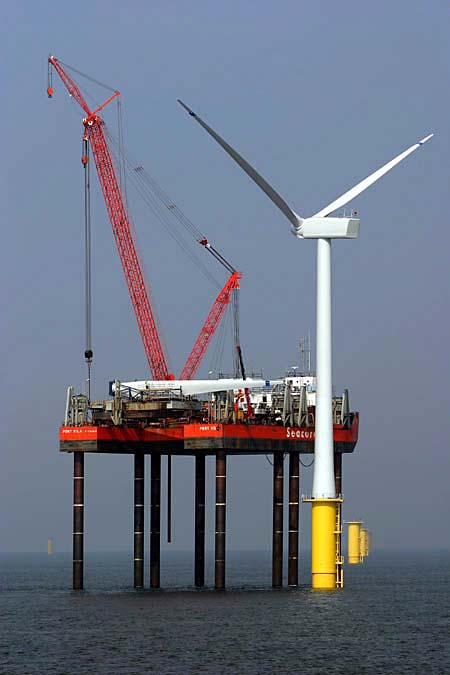
Offshore wind farming is a misleading avenue on two counts: Firstly it still suffers from the negative aspects of monopolistic control, requiring oil platform technology to deploy, therefore costs will ultimately be held above oil as an automotive energy source. Secondly; hills and ridges, where the rise in the land compresses air flow; wind velocity is typically 20% faster than it is offshore.

Consequently land based wind farms are now a lucrative business, with major manufacturers like Siemens, General Electric and Mitsubishi producing wind turbines, as well as smaller independents such as Nordex, Vestas and Enercon to name but a few.

In the UK the electricity industry consists of four parties:
  1. Electricity generators such as BNFL, Scottish Hydro Electric, as well as wind farmers and other electricity producers.
  2. National Grid, a public listed company which each year sets the Transmission Network Use of System (TNUoS) tariff within the UK.
  3. Electricity suppliers such as British Gas, E-on and nPower.
  4. Energy consumers: domestic and business.
Delivery and installation within the UK for a 2MW turbine typically costs between £1.5m to £2m, depending on delivery location and the particular requirements of the site. Fortunately the UK is the windiest country in Europe, with Scotland and Western Ireland enjoying average wind speeds in excess of 11 m/s, which compares very favourably with global wind speeds.

Wind farm revenue depends upon a number of factors primarily including wind class, National Grid tariff, government incentives and feed in tariff:
  • A wind class of 7m/s will yield around 30% efficiency, whereas 11m/s yields around 65% efficiency. This may be determined from the many online wind turbine efficiency graphs available, including this one for the Siemens SWT-2.3MW 101.
  • The TNUoS tariff is set yearly. The majority of our electricity is generated in Scotland and carried to England. For a 2MW turbine, in northern Scotland, National Grid will charge around £40,000 per annum in the worst case scenario to carry your electricity to the supplier. In the best case scenario, in the south and near London, National Grid will pay you around £10,000 per annum. Regions of the country are allocated a zone, each zone has a negative or positive tariff determined by distance from the bulk of the populace and the maintenance overheads for power transmission incurred.
  • To encourage transition to greener energy sources, the government offers Renewable Obligation Certificates (ROCs) which green energy generators should apply for and then sell to suppliers in order that the supplier achieve their renewable energy obligation target, which is set annually by the Office of Gas and Electricity Markets (Ofgem). For 2008, 9.1% of all electricity sold by each supplier constituted the renewable energy obligation which had to be fulfilled. Each tax year, for every megawatt under the obligation the supplier has to pay the buyout level set by Ofgem. In 2008 the minimum buy out level set by Ofgem was £35.76/MWh. For each megawatt of capacity, this ensures that the cost to the supplier will be at or just below the buyout rate of 3.5 p/KWh. This makes the green energy market safer for generators, since the capacity they did not achieve may also be traded at or near the buyout rate. Note that the ROCs remaining between energy generated and the farms capacity are tradeable with all suppliers.
  • In the UK non domestic energy consumers are required to use energy from green sources, failing to do so they are expected to pay the Climate Change Levy (CCL), which in 2008 was set at 0.47 p/KWh. Instead of paying this levy the non domestic consumer may instead pay using Levy Exemption Certificates (LECs) which are issued to green energy generators. Revenue from the sale of LECs will vary, though assuming these sell for 50% of the levy, a 2MW wind turbine would provide an additional £41,172 in revenue.
  • Insurance and maintenance are currently estimated to be around 3% for the total delivery and installation cost: approximately £50,000 per annum. No exact figures were available, though I feel this is quite a generous estimate. Obviously there are advantages to building wind farms of five or more turbines to reduce maintenance overheads.
  • Land rent will vary depending on the outlook of the land owner, from completely free ranging up to £10,000 per annum per turbine for large installations of ten or more that radically alter the skyline.
  • Finally the feed in tariff which you can typically expect back from the supplier is in the range of 4 to 5 p/kwh. As of April 2010, government proposed feed in tariffs will come into effect, alternatively Ofgem may increase the buyout level for ROCs.

The figures above are conservative and tend toward safe margins, they are also in approximate agreement with this article in the online edition of The Times. With just one 2MW turbine you may expect the following revenue per annum, which should return your initial investment within 5-7 years and continue generating profit for 20 to 25 years in total.

T.N.U.o.S. Tariff
£40,000.00
R.O.C. buyout per MW/h
£35.76
L.E.Cs. traded at 50% buyout
£41,100.00
Maintenance and Insurance
£50,000.00
Land rent
£10,000.00
MW/hs at 30% efficiency of 7 m/s
5259.6
Revenue at 30% of the 2010 proposed rate of 4.5p KW/h
£236,682
Revenue from remaining R.O.C.s traded at 75% buyout
£141,062
Total revenue for 30% efficiency
£318,844 p.a
MW/hs at 60% efficiency of 11 m/s
10519.2
Revenue at 60% at 2010 proposed rate of 4.5p KW/h
£473,364
Revenue from remaining R.O.C.s traded at 75% buyout
£56,425
Total revenue for 60% efficiency
£470,889 p.a

There seems to be a level of hysteria regarding wind farms amongst members of the public who I can only assume have some interest in preserving the existing energy monopoly. They protest that wind turbines are noisy, which if you visit one you will clearly hear for yourself this is not the case. They claim that wind farms are not efficient and do not produce revenue, yet house-hold name manufacturers produce them. Silently gathering thermal energy from the sun as it is converted into pressure variance in the atmosphere producing wind; there may honestly be less elegance in the design of a bird’s wing!

"Baseload" refers to the minimum energy requirement that must be met at any point in time, for critical services such as hospitals, fire stations, banks and so forth. Many advocates of the existing energy monopoly sight baseload as the central reason for discarding wind, solar and other natural sources of power generation. With the introduction of smart-grid technologies such as those now being rolled out by IBM, we have the opportunity to manage electricity usage during times of shortage. In these periods non-critical uses of energy, civic energy consumption such as 24 hour car-park lighting, fountains, rural street lighting, as well as electrical appliances on stand-by, may be reduced or switched off altogether. Going forward the base load issue may be resolved by storing energy generated during peak times, using technologies such as compressed air and advanced batteries. Modern compressed air vehicles such as Tata's air car, in comparison with petrol store 50W/h of electricity in one litre, whilst Encore's research finds that compressed air energy storage is 75% efficient, all indicating that mass energy storage solutions are already here. Clearly there are now revenue opportunities opening in the grid energy storage sector. 

With electric vehicles reaching 100 miles for just 96p of electricity, perhaps we should all take heed of Hampshire constabulary's inspiration for a greener planet.

Sunday, 10 May 2009

"News"


The information revolution has provided society with a plethora of new mediums, allowing anyone to reach everyone with their opinions and beliefs. In addition to these new ways to express views, new means of debate are emerging. As a result of this communication amongst the populace, individuals are being politicized; everyday challenging the opinions of others whilst defending their own.

Consequently the established political parties, in the past to some extent enjoying the privilege of being able to dictate social and economic policy are now becoming less representative of the opinions of the people. Concurrently and in order to balance this new shift, online news mediums, particularly the established newspapers are forming a bridge between the public and party members, in effect replacing grass roots canvassing perhaps without the tomatoes.

With this shift the newspaper is being redefined. In the past being part of the readership of a particular brand of newspaper identified the person culturally and politically, today's readership expect to be able to challenge from the moment of online publication, prior to arrival at a news stand, the opinions of the article's author, whether they be journalist, prime minister or reader. Thru open discussion the readership are empowered with the ability to redefine the cultural and political identity of the news brand.

Twitter, a recent invention which combines instant messaging with social networking is providing an innovative new source of news content. This is especially the case when combined with technologies like Monitter or Scribble Live, effectively empowering anyone with a mobile phone-camera to create a live text, image and audio feed to a website, as demonstrated during the recent G20 protests.

The question has been posed "Why use Twitter when you have e-mail?". Humans are much more imaginative given limited resources; it's as though the mind simply rationalizes: I have plenty, therefore there is nothing to worry about, relax; become prey. By limiting the number of characters in a tweet to 140, we're forced to be creative in what we tweet, whether poetry, image links, audio boos or you tube videos, the result a montage of multimedia; that 1990's buzz word that has quietly become ubiquitous. As with most forms of online social networking, the resulting chatter forms a layer of validation which I find has a positive affect on what Wole Soyinka refers to as the Quasi State and its communication channels.

Already it is quite possible to foresee a day when a news article is simply not news unless the reader may comment; we no longer wish to be lectured from the pulpit, we want fearless intelligent journalists and social commentators who come down and discuss amongst the readership. The addition of Twitter to the array of blogosphere lecterns is helping to create a hotbed of new journalistic talent, encouraging us all to police society ourselves.

Thursday, 7 May 2009

Publishing, File Sharing & Revolution


A shift is occurring which we have all been made aware of by the frequent cries of injustice from several members of the music industry. With the rise of Internet file sharing existing publishing establishment revenues are being undermined, though this has now largely come to be accepted, with those companies concluding that they will subsist on the profit generated by their back catalog of work still under copyright. Digital distribution removes the third party publisher from the loop, allowing more profit to go to the artist, perhaps a result that the majority of those in music publishing are secretly happy about.

This same transition is beginning to occur in the sphere of book publishing. With the arrival of Amazon's Kindle e-Reader, Sony's e-Reader, again the artist will be given the opportunity to enjoy increased revenue and liberated from the leeching publishers. Whilst we will always have film production companies, completely digital distribution of video rental is in the offing in the UK and already available in the US, with television soon to follow.

Many artists complain of the threat to their income created by the ease of digital copying and the rise of peer to peer file sharing, I personally welcome the prospect of having a home free of the various boxes, cases and shelves required to store transient human art forms. There are many advantages to the publishing revolution, with the UK in particular being so resistant to change, the opportunity to turn over the existing publishing aristocracy is very welcome.

The ease of digital duplication is often sighted as a setback, but to who? After all what is wrong with a dynamic that brings wealth to those artists whose art inspires pathos or edifies in such ways as to make us want to give our money?

Whilst many are currently bemoaning the pseudo-politicisation of the celebosphere, the removal of the publisher from transient art forms brings to the fore the question: is this art worth paying for? In time, perhaps redefining who our celebrities are.

Would future generations of children be raised expecting never to have to pay for books, music and films? Surely teaching your children to pay for what they like is a constructive tenet? After all we ourselves expect to be paid for work in the career we choose, so this initial instruction in the determination of excellence can only be mutually beneficial.

If all else fails the Internet provides the artist with a way to maintain a relationship with their audience, providing incentives to purchasing. Ultimately then the artist will be brought back into direct communication with the audience, as it was before recorded music or the printed press.

Sunday, 12 April 2009

The London Time Capsule

Is it me or does anyone else feel they have returned to the 20th century when using the London Tube? 

Each day I seem to spend a full hour in a World War II air raid shelter; one lacking the shared emotional energy of an impending death due to Nazi air raids, cut off from telecommunications and Internet services; not even an SMS can escape the time capsule! We enter into humdrum alienation, each acutely aware of each others presence, yet denied the liberty of expression, sat as we are: confrontationally; all dialogue silently discerned from this mornings choice of apparel. How I yearn for a telephone to break thru the rattling noise of the tube with a shrill rendition of the latest chart topping drivel! To overhear a reassuring phone conversation informing relatives of imminent arrival! To browse thru blogs, tweets, Googled answers or to send an email!

Tuesday, 7 April 2009

Altruistic Currency

When currency replaced bartering the moral value of one half of the exchange was lost. Since currency could be obtained from any source, traders were no longer in a position to judge the character of the opposing trader or customer by their goods. Consequently future economics were forever to favor unethical trade.

Today major energy consuming companies trade carbon offsets, whilst green energy producers trade renewable obligations certificates, just two examples of business ethics affecting profits.

With transition to a system of exclusively digital currency, or e-money, the ethical attributes may again be associated with money. Banks already maintain digital records of every electronic transaction. The next logical step is to add information about the source of every sum being exchanged, whilst also leaving a footprint on every account passed thru, so creating a currency market in which the ethical character of money has a value.

So Much Complexity, Is it Worth It?
  • Safer Business to Business Transactions : As money passes thru company or individual accounts, financial profiles of those entities are created. So providing more protection from fraudulent individuals like Madoff and Stanford
  • Protection from sub-prime lending: Any money borrowed, including details of interest rate, is part of an individual or organizations profile.
  • Providing a means of taxing black market produce, denoted import of unknown origin for instance. This would be applied during exchange.
  • Re-establishing a two sided moral value exchange.
  • Providing business and the consumer another way to make more ethical choices, when they can afford it.
  • Providing an additional way to incentivize ethical choices, e.g.: Recycling companies would offer greener money.
  • Allowing a shop or organization to more clearly identify itself ethically and be recognized as such by its trading profile: e.g. The Body Shop preferring money from green or charitable sources.
  • Associating an additional mark of respect with a persons occupation, for health care and teachers for instance.
  • Making money more noble by fitting the political profile of the individual or organization. Trading profiles could be published, displaying percentages of all money transacted in popular macro categories.
  • Imbuing a person or organisations economic presence with good will.

What Information Should be Maintained?
In light of Moore's law, we are in a position to store any amount of information about money. An initial list of suggestions for the types of information to record about money in a transaction might look like this:
  • Bank issue.
  • Resulting from export, from which country?
  • Resulting from import, produce from which country?
  • Resulting from import of unknown origin.
  • Charitable pay: healthcare, education, fire and police forces.
  • Carbon negative, neutral, positive value.
  • Location.
  • Non GM produce.
  • Organic produce.
  • Kosher produce.
  • Halal produce.
  • Fair trade.
  • Interest accrued in unknown investment.
  • Interest accrued in politically correct investment.
  • Previous owner.
Macro Groups
Clearly there are too many items of information for most people to make any quick and useful judgements about. In order to simplify this new classification of money, macro groups, relevant to each culture could be created for the various factions of society, composed of a number of limiting factors selected from the information available. For example:

General:
  • Local: favoring exports and locally produced revenue, within a specified distance.
  • Jewish: Kosher
  • Islamic: Halal
  • Christian: Fair trade, Organic, Humane.
  • Green: carbon neutral or positive, organic.
Business:
  • Local: favoring exports and locally produced revenue, within a specified distance.
  • Generally ethical.
Changes
For the majority of us, the consumers, our everyday retail experience will not differ by much. Since money paid from a recognised employer will carry the label 'Bank issue', essentially a standard form, into which money again pools when exchanged at the bank. Gradually retail outlets would specify a preference for various currency types, offering financial as well as other incentives.
We already make ethical decisions when we purchase, additionally financial profiles of shops and organisations we are buying from could be made available.
For business to business trading many avenues of altruism are made possible, creating the opportunities for a healthier capitalism.

Associating an ethical attribute with money clearly has many advantages. Yet such a transition also has many issues which must be resolved; to name two:
  • What or who defines the exchange rate between ethical hues? A problem arises: few would deny that practicing medicine is a noble endeavor, but exactly how should that belief be quantified and by who? And what of those occupations we regard as noble but are less skilled?
  • What happens in a predominantly corrupt culture?